
- Selected Recent Papers
- Latest Books
- Recent Books
- JOURNAL OF CHINESE ECONOMIC AND BUSINESS STUDIES, July 2021, Review Article, V.N. Balasubramanyam.
- SEOUL JOURNAL OF ECONOMICS, Volume 33 Number 4, 2020, Review Article, Djun Kil Kim
- BALLIOL COLLEGE ANNUAL RECORD, 2020, David Vines
- ECONOMIC AND POLITICAL WEEKLY, Volume LV, Number 50, December 2020, Review Article, Nagesh Kumar
- THE DEVELOPING ECONOMIES, December 2020, Machiko Nissanke
- JOURNAL OF DEVELOPMENT STUDIES, 2020, Review Article, Machiko Nissanke and V. N. Balasubramanyam
- BIBLIO, October-December 2020, Ram Singh
- GLOBAL POLICY, 30 June 2020, Duncan Green
- JOURNAL OF HUMAN DEVELOPMENT AND CAPABILITIES, June 2020, Rolph van der Hoeven
- ECONOMIC AND POLITICAL WEEKLY, Volume LV, Number 22, 30 May 2020, Rakesh Mohan
- INTERNATIONAL AFFAIRS, Volume 96 Issue 2, March 2020, Ramesh Thakur
- AFRICA ECONOMIC BRIEF, Volume 11, Issue 1, March 2020, Arkebe Oqubay
- INDIAN ECONOMIC REVIEW, March 2020, K.L. Krishna
- CHALLENGE, Vol.63 No.1, January-February 2020, Richard Falk
- THE HINDU, Edit Page article, 15 February 2020, C.T. Kurien
- THE HINDU, 9 February 2020, Harsh V. Pant
- UNU-WIDER BLOG, 20 January 2020, Arkebe Oqubay
- THE JAPAN TIMES, 5 January 2020, Ramesh Thakur
- BUSINESS STANDARD, 4 January 2020, T.N. Ninan
- FRONTLINE, 3 January 2020, U. Shankar
- FINANCIAL EXPRESS, 29 December 2019, Ashwani Kumar
- INDIAN EXPRESS, 22 December 2019, Sanjaya Baru
- OPEN, 22 November 2019, Siddharth Singh
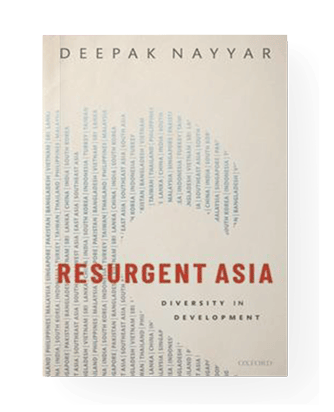
RESURGENT ASIA:
Diversity in Development
Oxford University Press, Oxford, 2019
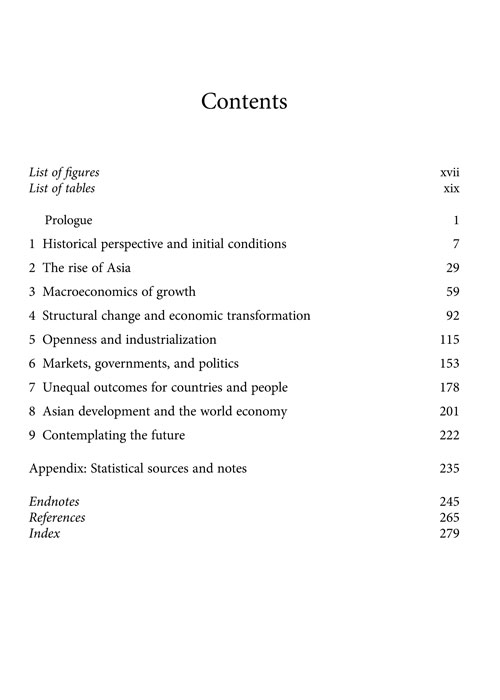
In 1970, Asia was the poorest continent in the world, marginal except for its large population. By 2016, it accounted for three-tenths of world income, two-fifths of world manufacturing, and one-third of world trade, while its income per capita converged towards the world average. However, this transformation was associated with unequal outcomes across countries and between people. The analysis disaggregates Asia into its four constituent sub-regions – East, Southeast, South and West – and further into fourteen countries – China, India, South Korea, Indonesia, Turkey, Taiwan, Thailand, Philippines, Malaysia, Singapore, Pakistan, Bangladesh, Vietnam and Sri Lanka – which account for more than four-fifths of its population and income.
This book enhances our understanding of development processes and outcomes in Asia over the past fifty years, draws out the analytical conclusions that contribute to contemporary debates on development, and highlights some lessons from the Asian experience for countries elsewhere. It is the first to examine the phenomenal changes, which are transforming economies in Asia and shifting the balance of economic power in the world, while reflecting on the future prospects in Asia over the next twenty-five years.
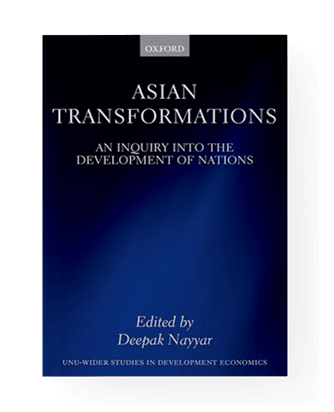
ASIAN TRANSFORMATIONS:
An Inquiry into the Development of Nations
Oxford University Press, Oxford, 2019
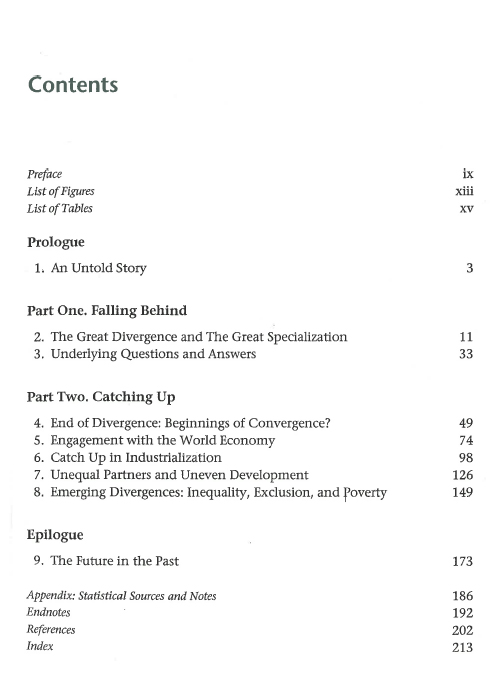
Abstract: Gunnar Myrdal published his magnum opus, Asian Drama: An Inquiry into the Poverty of Nations, in 1968. He was deeply pessimistic about development prospects in Asia. The fifty years since then have witnessed a remarkable social and economic transformation of Asia – even if it has been uneven across countries and unequal between people – that simply could not have been expected at the time. Asian Transformations: An Inquiry into the Development of Nations analyses the fascinating story of economic development in Asia spanning half a century.
The book sets the stage by discussing the contribution of Gunnar Myrdal to the debate on development then and now, and providing a long-term historical perspective on Asia in the world. It then uses cross-country thematic studies on governments, economic openness, agricultural transformation, industrialization, macroeconomics, poverty and inequality, education and health, employment and unemployment, institutions, and nationalisms, to analyse processes of change while recognizing the diversity in paths and outcomes. Specific country-studies on China, India, Indonesia, and Vietnam, and sub-region studies on East Asia, Southeast Asia, and South Asia highlight turning points in economic performance and discuss factors underlying success or failure.
Including in-depth studies by eminent economists and social scientists, Asian Transformations comprehensively examines the phenomenal changes that are transforming economies in Asia, and reflects on the future prospects for this continent over the next twenty-five years. It is a cohesive and multidisciplinary study of a rapidly changing economic landscape, which makes an important contribution to understanding the complexities of development from different perspectives.

- Journal of Human Development and Capabilities, Vol.16 No.3, August 2015, Rolph van der Hoeven
- Survival, Vol. 57 No. 4, 2015, Sanjaya Baru
- Pacific Affairs, Vol.88 No.4, December 2015, Kunal Sen
- Frontline, 12 June 2015, Sudipto Mundle
- Economic and Political Weekly, 11 October 2014, Vivek Chibber
- South Asia Economic Journal, September 2014, Richard Kozul-Wright
- Revue Tiers Monde, September 2014, Rosa Freire d'Aguia
- Business Standard, 8 July 2014, Y.V.Reddy
- The Book Review, 7 July 2014, Pritam Singh
- EH.Net, May 2014, Marianne Ward-Peradoza
- Choice, May 2014, R.S.Szulga
- The Sunday Tribune Spectrum, May 2014, M. M. Goel
- Decision, March 2014, Partha Ray
- Biblio, January-February 2014, Prem Shankar Jha
- The Hindu, 10 February 2014, K. Subramanian
- Indian Express, 21 December 2013, Subhomoy Bhattacharjee
- Bloomberg News, 15 December 2013, Pankaj Mishra
- The Pioneer, 8 December 2013, Excerpts
- Financial Express, 8 December 2013, Madan Sabnavis
CATCH UP:
Developing Countries in the World Economy
Published by Oxford University Press, Oxford, Hardback Edition 2013
Paperback Edition 2016
Abstract:
The object of this book is to analyze the evolution of developing countries in the world economy, situated in a long term historical perspective, from the onset of the second millennium but with a focus on the second half of the twentieth century and the first decade of the twenty-first century. It is perhaps among the first to address this theme on such a wide canvas that spans both time and space. In doing so, it highlights the overwhelming significance of what are now developing countries in the world until 200 years ago to trace their decline and fall from 1820 to 1950. The six decades since then have witnessed an increase in the share of developing countries not only in world population and world income but also in international trade, international investment, industrial production and manufactured exports which gathered momentum after 1980. The book explores the factors underlying this fall and rise to discuss the ongoing catch up in the world economy driven by industrialization and economic growth. Their impressive performance, disaggregated analysis shows, is characterized by uneven development. There is an exclusion of countries and people from the process. The catch up is concentrated in a few countries. Growth has often not been transformed into meaningful development that improves the wellbeing of people. Yet, the beginnings of a shift in the balance of power in the world economy are discernible. But developing countries can sustain this rise only if they can transform themselves into inclusive societies where economic growth, human development and social progress move in tandem. Their past could then be a pointer to their future.
- INDIAN JOURNAL OF LABOUR ECONOMICS, October-December, 2019, K.P. Kannan
- SOCIAL CHANGE, December 2018, Manoranjan Mohanty
- BIBLIO, December 2017
- ECONOMIC & POLITICAL WEEKLY, 11 November 2017, Thomas Timberg
- THE HINDU, 17 June 2017, Kandaswami Subramanian
- BUSINESS STANDARD, 4 May 2017, Laveesh Bhandari
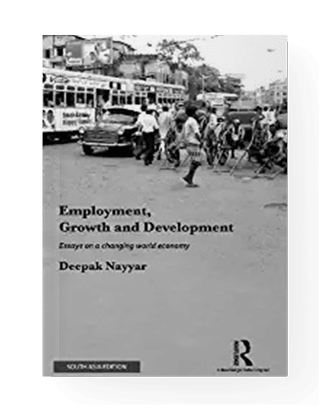
Employment, Growth And Development
Essays on a Changing World Economy
Routledge, London and New York, 2017
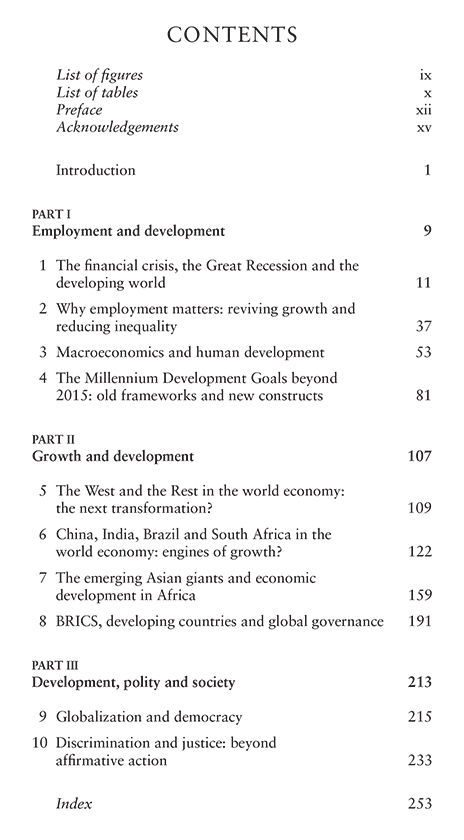
This book brings together ten selected essays by the author on employment, growth and development, to focus on challenges and opportunities – old and new – in the contemporary world economy. The essential theme that runs through the book is that there is a strong relationship not only between employment and growth but also between employment and development, where the causation runs in both directions. And it is employment that transforms economic growth into meaningful development by providing livelihoods and incomes to people. While the focus is often on developing countries, the discussion almost always considers industrialized countries as points of reference or comparison for analysis, since the latter are a large part of an interdependent world, in which problems faced by the two sets of countries are frequently connected and sometimes common. The essays also provide a macroeconomic analysis of development problems situated in the wider context of a changing world economy, exploring possible solutions, to examine the implications not only for countries but also for people.